

In Slovakia, around three out four citizens believe they have to be very cautious in relation to other people. Only one fourth believes they can generally trust others. A high level of distrust can affect societies in multiple ways, for example by increasing corruptive behaviour, creating excessive caution, complicating processes, polarising, or increasing the desire for a strong authoritative leader.
Solving long-term presence of distrust is therefore crucial for a society to function properly. In Slovakia, 21% to almost 26% of citizens generally trust others since the 1990s, showing consistent low levels of trust.
To increase trust in a society is to essentially improve social cohesion, which can be done in multiple ways. A method discussed in literature as one of the possible solutions is active participation in a group or organisation, such as membership in certain groups outside of one’s work or family.
When asked to rank certain factors from 1 to 10 according to their importance in Slovaks’ life satisfaction, social ties were ranked in top 3 by 38.41% of respondents (WVS wave 8). Social ties include community, relationships, loneliness, but also friends and family. As it is a wide category, it is hard to determine whether this percentage is driven by the importance of family and friends, rather than by belonging to a community. Nonetheless, we can say that social ties seem to be of a high importance to a significant part of Slovak society.
This blog works with the World Values Survey (WVS) data for Slovakia. The fieldwork was done by the FOCUS agency for the DEKK Institute, which officially represents the WVS in Slovakia.
Group membership: Bridging and bonding
Belonging to a group can have both positive and negative effects on trust and polarisation. It is crucial not to fall into two traps. First by having an ingroup favouritism, meaning “we are better than them” mentality, where we view everybody outside of our group as inferior. Second, by expressing outgroup homogeneity, meaning “they are all the same”, where we understand people based on the group they are in, rather than understanding them as individuals first.
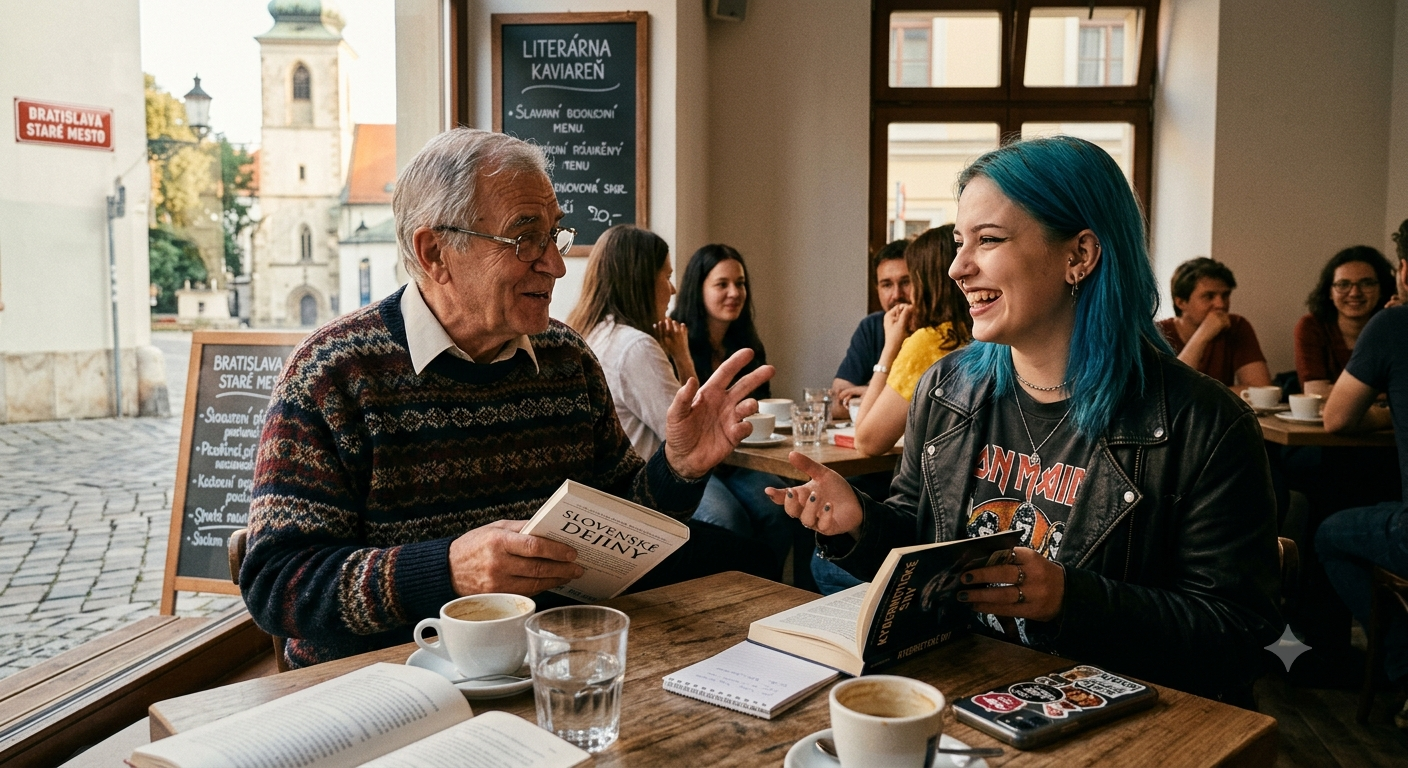
Participation in groups outside of family, work, and close friendships draws people out of their immediate social bubble and into contact with people they would rarely meet otherwise. By engaging with people from different parts of society, across generations, class, education levels, professions, political beliefs and worldviews, we can be exposed to different ways of life and perspectives. When someone enters an interaction with a stereotyped view of older people, that engagement itself can become corrective, demonstrating that no group is as uniform as preconceived notions imply. Rather, they are individual people with their own beliefs, likes and dislikes, just like any other person in a society. In theory, this should decrease polarisation.
Based on Putnam (1995), it is important to distinguish between bridging and bonding groups, as one should help with social cohesion and depolarisation, whereas the other type can intensify the problem rather than alleviate it. Bonding refers to relations within a group or a community. (The terms come from Putnam’s classification of bonding and bridging social capital, with social capital being defined as „networks and the associated norms of reciprocity".)
Bridging refers to relations across groups and communities, e.g. across class, religious beliefs or socioeconomic background. Bonding groups operate within established communities or groups, so they do not generally help with social cohesion, as the members of that group do not step outside their bubble. Rather, it can reinforce existing divisions in society. Bridging groups, on the other hand, provide a platform, where people from different communities/groups can connect, which helps with social cohesion.
It is important to avoid falling into two traps: the "we are better than them" mentality, and viewing the outgroup as homogeneous – "they are all the same".
This is not to say that bonding groups are harmful to society. They are, in fact, crucial, as they can provide a sense of belonging, recognition and legitimacy. Additionally, belonging to a group does not result in anti-outgroup sentiment at its core. Anti-outgroup sentiment rather happens as a result of polarisation and low interpersonal trust. Typically, a group will not be strictly bonding or bridging. Most groups could be identified as both.
For group membership to have a positive effect on social cohesion and trust in a society, active membership is important. That is, those that actively participate in events and meet with other people of the group. Passive or non-active membership can mean only paying a membership fee, being subscribed to a newsletter, and meeting the other group members rarely, if at all. Membership also has to be voluntary.
Data on Slovakia and the world
In Slovakia, almost half of the population (46,52%) are not members of any group (WVS wave 8). However, there is no optimal percentage of participation in groups which should make a society more trusting and less polarised. Rather, as discussed above, the importance lies in the quality of group participation, meaning active membership in bridging organisations.
About a third of Slovaks are active members of at least one group (27,41%) and 8,53% overall are active members of more than one group (WVS wave 8) . Unfortunately, WVS data for Slovakia do not allow us to determine whether group membership is a factor in increasing trust, as the relevant categories contain counts too low to draw any reliable conclusions. Still, there are studies which have been able to show a link between group membership and increase of social cohesion. One study looked at specific groups in Flanders (Belgium), and found that hobby groups, art groups, humanitarian organisations, and sports organisations have more heterogeneous (diverse) people within the group. Meaning they would be identified as bridging. In the specific groups they studied, members have the opportunity to engage with people of different backgrounds to that of their own. They argue that there is a link between bridging group membership and civic attitudes. Putnam also highlights these types of groups as crucial.
Voluntary active group membership, particularly in hobby-based groups (arts, sports…) and humanitarian groups allow people to know each other first as people, before they know each other’s political beliefs. According to Slovak sociologist, Zuzana Fialová, it can help when people cooperate on a shared project or goal through such engagement. This allows them to build interpersonal trust first. Only after this trust is established, can we engage in discussions on divisive topics, while still seeing the other person as a person first, and not as their label.
In Slovakia half of the population are not members of any group. However, there is no optimal percentage which should make a society more trusting and less polarised.
Based on cross-country WVS wave 7 data, we can see an increase in trust levels in these groups as compared to overall interpersonal trust in society. These results, however, should be taken lightly, as they are based on 66 countries and we cannot determine group membership as having a causal link with increasing trust based on this data. Nonetheless, we can see a pattern.
Based on the latest public World Values Survey data (WVS wave 7) global interpersonal trust was at 24% and caution was expressed by 75% of respondents. Active members of humanitarian organisations, sports and most importantly art groups, are showing higher share of interpersonal trust, as shown in the graph below.
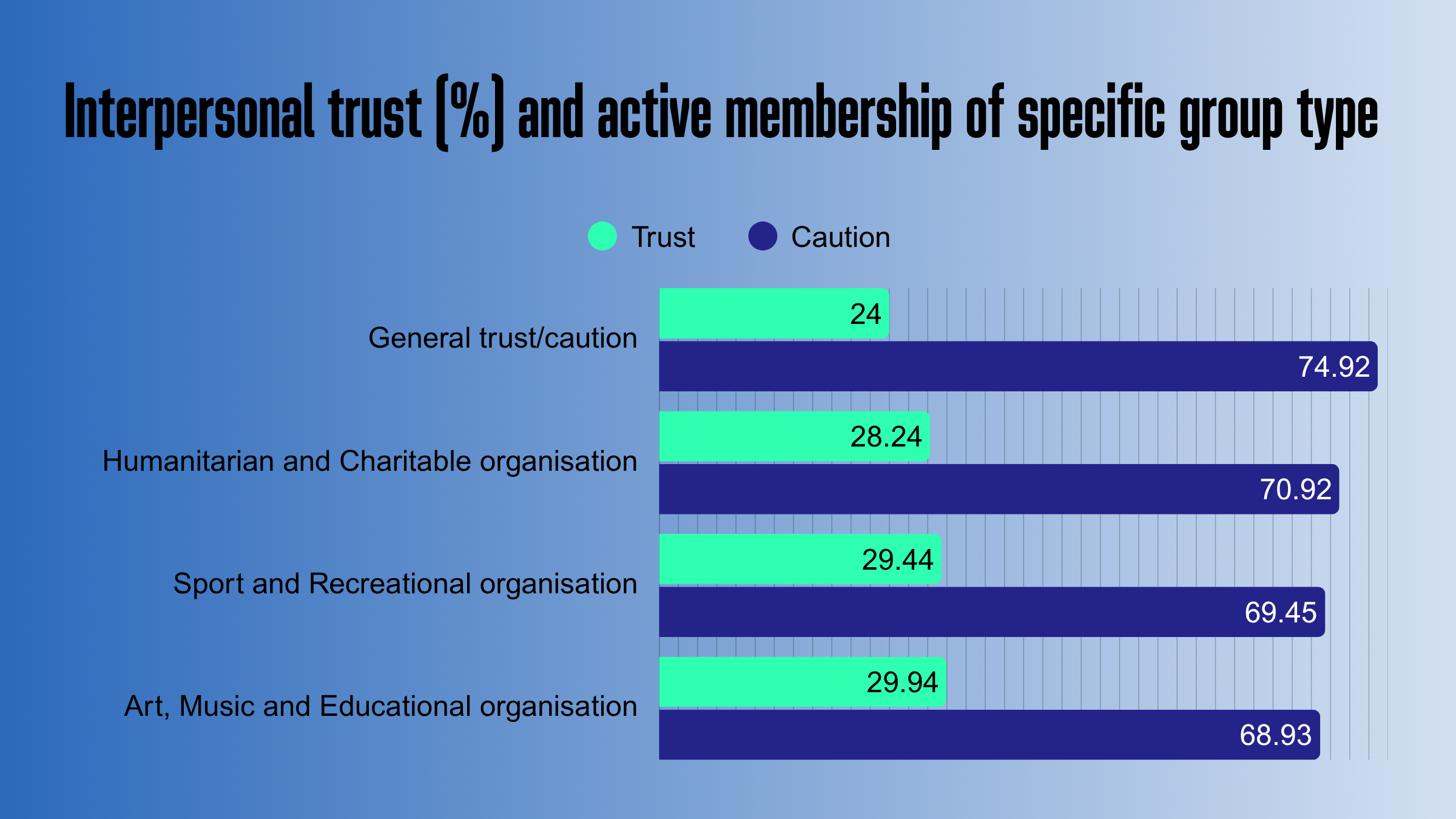
The plot shows that across all three group types examined active members consistently report higher levels of trust than the general population average. Members of humanitarian and charitable organisations show a trust rate of 28.24%, those in sport or recreational organisations 29.44%, and members of art, music or educational organisations 29.94%, each representing a meaningful increase over the baseline. While caution remains the dominant response across all categories, the pattern suggests that active group membership is associated with a moderately but consistently higher propensity to trust.
Supporting active membership in bridging groups, particularly related to art, sport or humanitarian work, is identified by multiple authors as one way to increase trust in a society. We can find some evidence of that by looking at WVS data, although given the descriptive nature of the analysis we should be careful not to draw causal conclusions. Nonetheless, such groups seem to be able to provide the base for understanding the other people better, by establishing a relationship first. This mutual knowing is identified as a crucial point.
What if there are “too many” members?
However, the bigger the group, the less likely and increasingly impossible it becomes to create a relationship with other members of the group. If we support active membership of groups, is there a point where too many members disable the bridging group from actually interacting? We could argue that Slovakia is theoretically just a very large bridging group, just as any other country. What unites people there? Why do people choose to be and stay a member of this group? Does active membership increase trust?
Estonia is an example of a country that made social cohesion a deliberate strategic priority, particularly through inclusion, education, removing language barriers and defining what it means to be Estonian. In bridging groups of much larger scale, common stories and symbols may be the only thing that lets us identify the other person as a member of our group.
Think of ice hockey in Slovakia: we are all a member of one big group (Slovakia), we are all together under one symbol (the Slovak flag), and we are all cheering for one team (the national ice hockey team). Despite not knowing the other fans personally, rooting for a national sports team brings members of a group closer. It connects people across demographic and socio-economic indicators.
What is Slovak “sisu”?
Nevertheless, a couple of yearly international sports events cannot solve long-term issues with polarisation. Additionally, if the team you root for is not winning or not playing as you believe it should, this can create feelings of shame and anger. Besides rooting for a sports team, what unites us? In Finland, for example, everyone is familiar with ‘sisu’, which is a deeply ingrained cultural belief in resilience and the capacity to endure adversity. It is regarded as central to Finnish national identity, playing a meaningful role in national security. Although it is an old term, it was shaped as a key part of the national identity mainly during the country's struggle for independence from Russia in 1917 and later during the Winter War.
Slovakia needs to ask a similar question. What ideas do we want to identify with? What do we feel when we see the Slovak flag? What is our “sisu”?
